
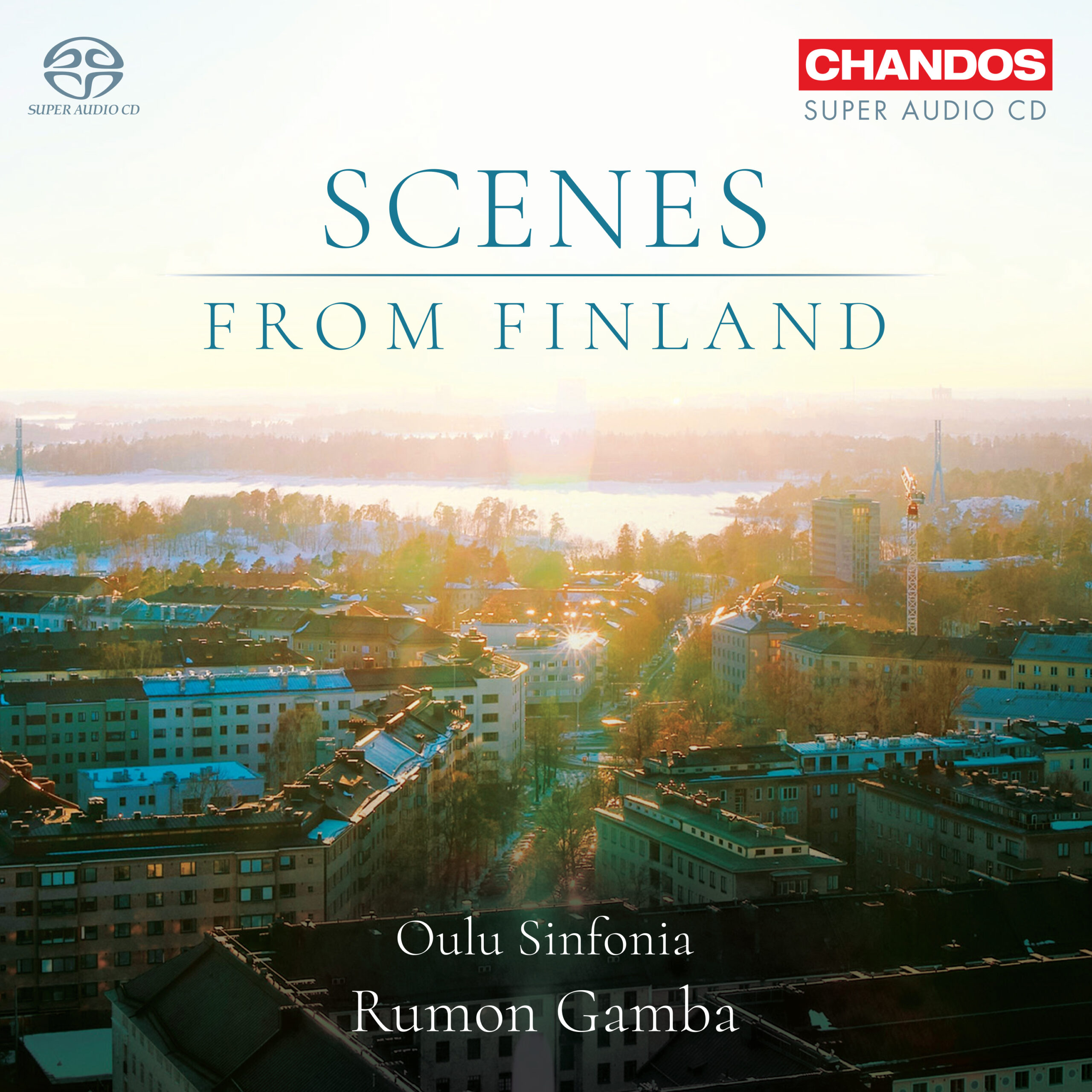
Chandos Records has released Scenes From Finland on Friday 7 August 202t. The album features Oulu Sinfonia under the baton of Chief Conductor Rumon Gamba. Scenes From Finland includes music by Jean Sibelius, Selim Palmgren, Einar Englund and Kalervo Tuukkanen.
Scenes From Finland is the third instalment in a trilogy exploring the richness and diversity of Finnish symphonic music, placing lesser-known masterpieces by contemporaries of Finland’s best-known composers alongside the established orchestral repertoire from a nation finding its independence and embracing modernity. The newly released album focuses on music composed for the stage and screen. The two previous albums in the trilogy are Overtures From Finland (2023), featuring orchestral overtures, and Pictures From Finland (2025), which paints a musical portrait of Finnish landscapes.
The album will be released as CD, and it can also be streamed on the platforms listed here.
Chandos Records and Rumon Gamba describe the background to the album as follows:
Jean Sibelius composed Scaramouche, a ballet-pantomime commissioned in 1912 by his publishers, for a play by Poul Knudsen. The story line reflects the immense early twentieth-century interest in clowns and the commedia dell’arte, and in erotic desire, death, and the macabre, the same phenomena that produced Igor Stravinsky’s Pétrouchka and Arnold Schoenberg’s Pierrot Lunaire.
The album presents a concert suite compiled by Rumon Gamba from the music of Sibelius’s ballet Scaramouche. Gamba describes the suite as follows:
“I love the music Sibelius wrote for Scaramouche and found out that his son-in-law, conductor Jussi Jalas, made a concert suite with the composer’s blessing. Whilst an old recording of that suite exists, sadly there are no materials for performance. I decided therefore to make my own suite, based loosely on that Jalas version.”
Best known as a composer of piano music, Sibelius’s younger contemporary Selim Palmgren also wrote music for the theatre, and his score for the fairy-tale play Tuhkimo ja kuninkaantytär (Tuhkimo and the Princess), dates from 1902–03. Larin-Kyösti’s play recounts the adventures of a passionate youth, Tuhkimo, and combines features of the familiar Cinderella story with elements drawn from a wide range of folk tales and fables.
Einar Englund studied composition with Palmgren (and later Aaron Copland). His soundtrack for Erik Blomberg’s 1952 film Valkoinen peura (The White Reindeer) was particularly acclaimed and won best prize for original music in the Jussi Awards (the Finnish Oscars) in the year of its release.
Kalervo Tuukkanen taught for three years at Viipuri Institute of Music before serving as Kapellmeister in Pori, on Finland’s west coast, in 1942–44. He was one of the founding members of Suomen Säveltäjät (the Finnish Composer’s Association) and his composition Karhunpyynti (Bear Hunting) was awarded a silver medal in the 1948 Cultural Olympics in London (where Finland impressively topped the medal table). Joulusarja (Christmas Suite) is taken from his 1953 score for a production of the play Die Erzählung des letzten Hirten (The Tale of the Last Shepherd) by Walter Bauer and its five movements cover the key moments in the Christmas story.
Text: Oulu Sinfonia/Chandos Records
Photo: Scenes From Finland album cover